Culinary Concoctions by Peabody

June 29, 2007

Im”PIE”rfection

Filed under: chocolate, dessert — peabody @ 2:10 pm

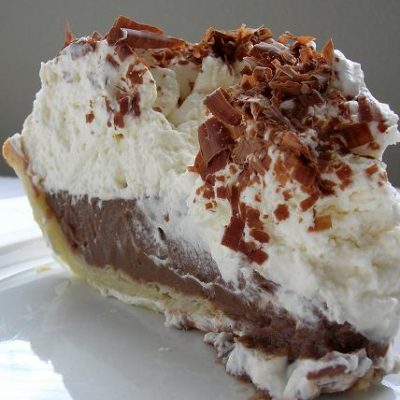
So I got lots of comments about how “perfect” my bagels looked. I tried to post back to people that those were only the “good” ones. Trust me there were some not so great ones. So I thought I would showcase something I am horrible at making….pie.
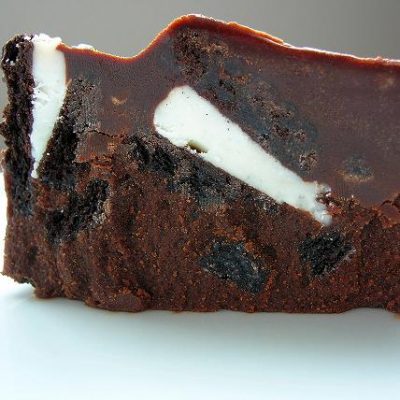
I think I am so bad at it because I just really don’t like pie all that much. I would much rather have a grunt, a Betty or a cobbler before I would reach for a pie. The only exception being Key Lime Pie, which I refuse to make at home because I would eat it all the time. So my pie making skills are less than spectacular. My crust is hit or miss. I am a bad pincher when I go around the crust, always uneven and usually have fingernail marks in it. The filling I always seem to do okay with but put it all together and it just isn’t exciting. Case in point, my very gloppy chocolate cream pie….imperfection galore. Now granted it does taste good but definitely anything less than photogenic.
My filling is a combo of different recipes from over the years that got joined together. I could not even begin to tell you where those come from. I like the use of the different chocolates but you could just stick with one or the other if you prefer.
So there you have it faithful blog readers, some pictures of my very imperfect looking pie. I better go bake something quick that looks good before I get down on myself :P.

Chocolate Cream Pie
Filling:

3 ounces semi sweet chocolate, finely chopped
3 ounces milk chocolate, finely chopped
1/2 cup heavy cream
1/2 cup plus 2 TBSP granulated sugar
5 TBSP cornstarch
2 squares unsweetened baking chocolate, finely chopped
Pinch salt
3 egg yolk
2-1/3 cups whole milk, divided
1 tsp. vanilla

For Filling:

Place chocolates(milk, semi sweet and unsweetened) into small heatproof bowl. In small saucepan over low heat, heat cream until very hot, stirring occasionally. Remove from heat. Add cream to chocolate. Allow to stand for a minute, then stir or whisk gently until smooth. Set aside.

In a  heavy-bottomed pot, sift sugar, cornstarch, and salt. Whisk to combine well. Set aside. Place egg yolks in small bowl; with fork, gradually beat in 1/3 cup milk. Pour yolk mixture into sugar mixture in pot. With whisk, stir until combined, scraping pot sides and bottom with rubber spatula. You may have some lumps, that is okay.

In small saucepan over low heat, heat remaining 2 cups milk until very hot, stirring occasionally. Very gradually add to egg mixture, stirring constantly. When all of milk has been added, place mixture over medium heat.

Stir until mixture comes to a boil. Boil and stir 1-1/2 minutes; remove from heat. It might get lumpy at first but will smooth out.

Immediately add melted chocolate mixture and vanilla. Gently stir just until combined, then strain through fine-meshed strainer. Without waiting, fill the cooled pie crust. I don’t fill all the way because I like more whipped cream topping but if you use the whole amount it will fill the whole pie crust up. Place a piece of plastic wrap over the pie, having it touch the filling so that a skin wont form in the refrigerator; chill for at least 4 hours.

For Topping:

1 cup heavy cream
2 tablespoons confectioners’ sugar
1/2 teaspoon vanilla extract

 In a mixing bowl, beat cream with confectioners’ sugar and 1/2 teaspoon vanilla extract until stiff. Spread over chocolate cream pie(I used a piping bag to make it look a little better…didn’t help much :) ) . Garnish with chocolate shavings and place back in refrigerator until ready to serve. Store leftover chocolate cream pie in refrigerator.

Basic Flaky Pie Crust

Ingredients:

8 Tablespoons unsalted butter, cold
1 1/3 cups plus 4 teaspoons pastry flour or bleached all-purpose flour
¼ teaspoon salt
1/8 teaspoon baking powder (optional: if not using, double the salt)
2 ½ to 3 ½ Tablespoons heavy cream
1 ½ teaspoons cider vinegar
Method:
Divide the butter into two parts, about two-thirds to one-third (5 tablespoons and 3 tablespoons). Cut the butter into 3/4 inch cubes. Wrap each portion of butter with plastic wrap. Refrigerate the larger amount and freeze the smaller for at least 30 minutes. Place the flour, salt, and optional baking powder in a reclosable gallon-size freezer bag and freeze for at least 30 minutes.

Food processor method:
Place the flour mixture in a food processor with the metal blade and process for a few seconds to combine. Set the bag aside.

Add the larger amount of butter cubes to the flour and process for about 20 seconds or until the mixture resembles coarse meal. Add the remaining frozen butter cubes and pulse until all of the frozen butter is the size of peas. (Toss with a fork to see it better.)

Add the lowest amount of the ice water and the vinegar and pulse 6 times. Pinch a small amount of the mixture together between your fingers. If it does not hold together, add half the remaining water and pulse 3 times. Try pinching the mixture again. If necessary, add the remaining water, pulsing 3 times to incorporate it. The mixture will be in particles and will not hold together without being pinched.

For tiny 1 inch tartlets, omit the baking powder and allow the processing to continue just until a ball forms. The additional mixing produces a dough that is slightly less flaky but ensures that it will not puff out of shape in the tiny molds.

Spoon the mixture into the plastic bag. (For a double-crust pie, it is easiest to divide the mixture in half at this point.)

Holding both ends of the bag opening with your fingers, knead the mixture by alternately pressing it, from the outside of the bag, with the knuckles and heels of your hands until the mixture holds together in one piece and feels slightly stretchy when pulled.

Wrap the dough with plastic wrap, flatten it into a disc (or discs) and refrigerate for at least 45 minutes, preferably overnight. (For a pie shell and lattice, divide it in a ratio of two thirds: one third-use about 9.5 ounces for the shell and the rest for the lattice, flattening the smaller part into a rectangle.)

Hand method:
Place a medium mixing bowl in the freezer to chill.

Place the flour, salt, and optional baking powder in another medium bowl and whisk to combine them. Use a pastry cutter or rub the mixture between your fingers to blend the larger portion of the butter into the flour until it resembles coarse meal.

Spoon the mixture, together with the cold butter, into a reclosable gallon-size freezer bag. Expel any air from the bag and close it. Use a rolling pin to flatten the butter into flakes. Place the bag in the freezer for at least 10 minutes or until the butter is very firm.

Transfer the mixture to the chilled bowl, scraping the sides of the bag. Set the bag aside. Sprinkle the ice water and vinegar onto the mixture, tossing it lightly with a rubber spatula. Spoon the loose mixture back into the plastic bag. (For a double-crust pie, it is easiest to divide the mixture in half at this point.)

Holding both ends of the bag opening with your fingers, knead the mixture by alternately pressing it, from the outside of the bag, with the knuckles and heels of your hands until the mixture holds together in one piece and feels slightly stretchy when pulled.

Wrap the dough with plastic wrap, flatten it into a disc and refrigerate for at least 45 minutes, preferably overnight.

Yield: One 9-inch pie crust
Adapted from From The Pie and Pastry Bible by Rose Levy Beranbaum (Charles Scribners, 1998)

June 27, 2007

Bagelmania

Filed under: Blogging Event, baked goods — peabody @ 1:08 am

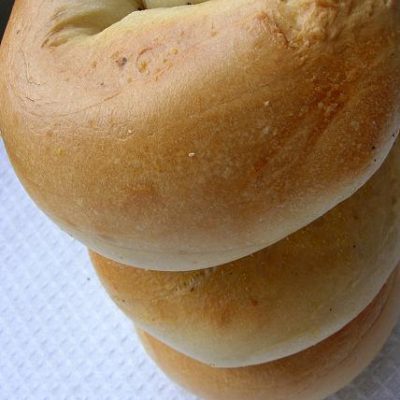
Bagelmania is here courtesy of the Daring Bakers(Freya and Jenny to be exact). This month’s challenge was to make, as the recipe says, Real Honest Purist’s Bagels. Now it has been a few years since I made bagels, and it had been a really long time since I made plain bagels. I like most people buy their bagels. But it is fun to do and if you have never made them before it is definitely something you should add to your list of things to learn to do.
One thing many of the daring bakers learned during this task was that though you think you don’t need anymore flour, you are to use all of the flour! For me, my quirks were that I only had one sink(a rebel no doubt) while the rest just floated. They should sink and then float…gracefully according to the recipe. Well there was nothing graceful about how my one bagel floated to the top. My other problem was that I did this rushed and so I did not really pay attention to the fact that during half proofing they pretty much whole proofed and there were no more holes in my bagels….just a bagel butt crack. I did have one hole(see photo of poppyseed bagel below). But the rest, nothing but bagel butt crack I tell ya! I did deviate on one part. I did egg wash my plain bagels. I just could not stand them not being brown, though they were no where near as brown as you would like them. I of course only took pictures of the halfway decent looking ones too.

Real Honest Purist’s Bagels

INGREDIENTS:
6-8 cups bread (high-gluten) flour
4 tablespoons dry baking yeast
6 tablespoons granulated white sugar or light honey (clover honey is good)
2 teaspoons salt
3 cups hot water
a bit of vegetable oil
1 gallon water
3-5 tablespoons malt syrup or sugar
a few handfuls of cornmeal
EQUIPMENT:

large mixing bowl
wire whisk
measuring cups and spoons
wooden mixing spoon
butter knife or baker’s dough blade
clean, dry surface for kneading
3 clean, dry kitchen towels
warm, but not hot, place to set dough to rise
large stockpot
slotted spoon
2 baking sheets
HOW YOU DO IT:

First, pour three cups of hot water into the mixing bowl. The water should be hot, but not so hot that you can’t bear to put your fingers in it for several seconds at a time. Add the sugar or honey and stir it with your fingers (a good way to make sure the water is not too hot) or with a wire whisk to dissolve. Sprinkle the yeast over the surface of the water, and stir to dissolve.

Wait about ten minutes for the yeast to begin to revive and grow. This is known as “proofing” the yeast, which simply means that you’re checking to make sure your yeast is viable. Skipping this step could result in your trying to make bagels with dead yeast, which results in bagels so hard and potentially dangerous that they are banned under the terms of the Geneva Convention. You will know that the yeast is okay if it begins to foam and exude a sweetish, slightly beery smell.

At this point, add about three cups of flour as well as the 2 tsp of salt to the water and yeast and begin mixing it in. Some people subscribe to the theory that it is easier to tell what’s going on with the dough if you use your hands rather than a spoon to mix things into the dough, but others prefer the less physically direct spoon. As an advocate of the bare-knuckles school of baking, I proffer the following advice: clip your fingernails, take off your rings and wristwatch, and wash your hands thoroughly to the elbows, like a surgeon. Then you may dive into the dough with impunity. I generally use my right hand to mix, so that my left is free to add flour and other ingredients and to hold the bowl steady. Left-handed people might find that the reverse works better for them. Having one hand clean and free to perform various tasks works best.

When you have incorporated the first three cups of lour, the dough should begin to become thick-ish. Add more flour, a half-cup or so at a time, and mix each addition thoroughly before adding more flour. As the dough gets thicker, add less and less flour at a time. Soon you will begin to knead it by hand (if you’re using your hands to mix the dough in the first place, this segue is hardly noticeable). If you have a big enough and shallow enough bowl, use it as the kneading bowl, otherwise use that clean, dry, flat countertop or tabletop mentioned in the “Equipment” list above. Sprinkle your work surface or bowl with a handful of flour, put your dough on top, and start kneading. Add bits of flour if necessary to keep the dough from sticking (to your hands, to the bowl or countertop, etc….). Soon you should have a nice stiff dough. It will be quite elastic, but heavy and stiffer than a normal bread dough. Do not make it too dry, however… it should still give easily and stretch easily without tearing.

Place the dough in a lightly oiled bowl, and cover with one of your clean kitchen towels, dampened somewhat by getting it wet and then wringing it out thoroughly. If you swish the dough around in the bowl, you can get the whole ball of dough covered with a very thin film of oil, which will keep it from drying out.

Place the bowl with the dough in it in a dry, warm (but not hot) place, free from drafts. Allow it to rise until doubled in volume. Some people try to accelerate rising by putting the dough in the oven, where the pilot lights keep the temperature slightly elevated. If it’s cold in your kitchen, you can try this, but remember to leave the oven door open or it may become too hot and begin to kill the yeast and cook the dough. An ambient temperature of about 80 degrees Farenheit (25 centigrades) is ideal for rising dough.

While the dough is rising, fill your stockpot with about a gallon of water and set it on the fire to boil. When it reaches a boil, add the malt syrup or sugar and reduce the heat so that the water just barely simmers; the surface of the water should hardly move.

Once the dough has risen, turn it onto your work surface, punch it down, and divide immediately into as many hunks as you want to make bagels. For this recipe, you will probably end up with about 15 bagels, so you will divide the dough into 15 roughly even-sized hunks. Begin forming the bagels. There are two schools of thought on this. One method of bagel formation involves shaping the dough into a rough sphere, then poking a hole through the middle with a finger and then pulling at the dough around the hole to make the bagel. This is the hole-centric method. The dough-centric method involves making a long cylindrical “snake” of dough and wrapping it around your hand into a loop and mashing the ends together. Whatever you like to do is fine. DO NOT, however, give in to the temptation of using a doughnut or cookie cutter to shape your bagels. This will pusht them out of the realm of Jewish Bagel Authenticity and give them a distinctly Protestant air. The bagels will not be perfectly shaped. They will not be symmetrical. This is normal. This is okay. Enjoy the diversity. Just like snowflakes, no two genuine bagels are exactly alike.

Begin to preheat the oven to 400 degrees Farenheit.

Once the bagels are formed, let them sit for about 10 minutes. They will begin to rise slightly. Ideally, they will rise by about one-fourth volume… a technique called “half-proofing” the dough. At the end of the half-proofing, drop the bagels into the simmering water one by one. You don’t want to crowd them, and so there should only be two or three bagels simmering at any given time. The bagels should sink first, then gracefully float to the top of the simmering water. If they float, it’s not a big deal, but it does mean that you’ll have a somewhat more bready (and less bagely) texture. Let the bagel simmer for about three minutes, then turn them over with a skimmer or a slotted spoon. Simmer another three minutes, and then lift the bagels out of the water and set them on a clean kitchen towel that has been spread on the countertop for this purpose. The bagels should be pretty and shiny, thanks to the malt syrup or sugar in the boiling water.

Once all the bagels have been boiled, prepare your baking sheets by sprinkling them with cornmeal. Then arrange the bagels on the prepared baking sheets and put them in the oven. Let them bake for about 25 mintues, then remove from the oven, turn them over and put them back in the oven to finish baking for about ten minutes more. This will help to prevent flat-bottomed bagels.

Remove from the oven and cool on wire racks, or on a dry clean towels if you have no racks. Do not attempt to cut them until they are cool… hot bagels slice abominably and you’ll end up with a wadded mass of bagel pulp. Don’t do it.

TO CUSTOMIZE BAGELS: After boiling but before baking, brush the bagels with a wash made of 1 egg white and 3 tablespoons ice water beaten together. Sprinkle with the topping of your choice: poppy, sesame, or caraway seeds, toasted onion or raw garlic bits, salt or whatever you like. Just remember that bagels are essentially a savory baked good, not a sweet one, and so things like fruit and sweet spices are really rather out of place.

Adapted from http://www.jewish-food.org/recipes/brea0007.htm

To see more Bagelmania, check out what the other Daring Bakers did with theirs(see blogroll that says…what else, Daring Bakers).


June 25, 2007

Basque in it’s glory….

Filed under: dessert, fruit — peabody @ 11:07 am

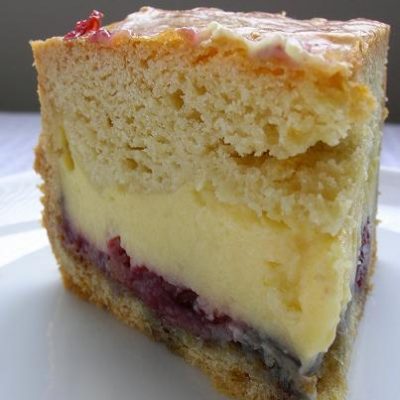
There are some recipes I always say I am going to make, every time I pass it in the cookbook, yet never do. I know you do this too. I have hundreds of “must make” neglected recipes. So while flipping through American Boulangerie I ran across my giant pink sticky note starring me down. There was a beautiful custard filled cake that I have told my self a dozen times I would make. As it would happen I recently received a jar of homemade black cherry jam…and well, the recipe calls for black cherry jam. The light bulb went off above my head and I set out to make this south of France treat. My first problem was that I had no flan ring. I used a 4 ½-inch spring form pan(to make 2 of them). So my top crust was WAY more thick than it should be(not that it was a real problem, it just didn’t look like the top in the cookbook). If you are a pastry cream fan, you will enjoy this dessert, as the majority of it is pastry cream or as I like to call it “next pants size up please cream.” I was most fascinated by this dessert because the pastry cream is baked, not something that happens to pastry cream that often. Oddly enough it pretty much tastes the same as when it is unbaked. If you are anti-alcohol you can easily leave out the rum.

Gateau Basque

Pastry :

4 ounces unsalted butter, at room temperature
½ cup sugar
freshly grated zest of 1 lemon
1/8 tsp salt
1 extra-large egg
1 extra-large egg yolk
1 ½ cups all-purpose flour
1 tsp baking powder

Filling:

¼ cup plus 2 TBSP sugar
¼ cup all purpose flour
4 extra-large egg yolks
1 ¾ cups whole milk
½ vanilla bean, split lengthwise and scraped
1 TBSP light rum
½ tsp almond extract
¾ cup black cherry preserves
1 egg, beaten, for egg wash

1.To make the pastry: In a bowl of an electric mixer fitted with the paddle attachment, cream the butter, sugar, lemon zest, and salt on low speed, until smooth. Add the egg and egg yolk and mix until blended. In a small bowl, whisk together the flour and baking powder. Add the flour mixture to the butter mixture and mix on low speed until a soft dough forms. Turn the dough out onto a lightly floured work surface and divide it into tow pieces. Wrap in plastic wrap, and refrigerate until firm, at least 30 minutes.
2.To make the filling: In a medium bowl, whisk together the sugar and flour. Add the egg yolks and ¼ cup of the milk and whisk until smooth. In a medium saucepan, heat the remaining 1 ½ cups milk with the vanilla bean and its scrapings, until steaming. While whisking, pour ½ cup of the hot milk into the yolk mixture. Whisk the yolk mixture back into the hot milk and cook over medium heart, whisking, until boiling and thick, about 4 minutes. Strain the filling through a fine mesh sieve into a bowl. Discard the vanilla bean. Stir in the rum and almond extract. Place a piece of plastic wrap directly on the surface of the pastry cream to prevent a skin from forming and refrigerate until cool, at least 2 hours and up to 6 hours.
3.Preheat the oven to 325F. Set a 9-inch diameter flan ring with 1-inch sides on a baking sheet lined with parchment paper. Spray the inside of the pan with vegetable oil spread. Working between two piece of plastic, roll out the larger disk of dough to an 11-inch round. Remove the plastic wrap and ease the dough into the flan ring, pressing it into the corners and leaving the overhang. Spread the preserves evenly over the bottom of the pastry shell. Add the pastry cream in dollops and then carefully spread it over the preserves. Working between two more pieces of plastic wrap, roll out the second disk of dough to a 10 inch round and lay it over the pastry cream. Press the edges of the top and bottom crust together and cut off the overhang using the back edge of of a knife. Using the tines of a fork, lightly score the top crust in a crosshatch pattern. Brush the top of the tart with the remaining egg wash. With the tip of a knife, poke 3 holes in the top to allow steam to escape.
4.Bake in the center of the oven for 55 minutes or until the top is golden brown. Transfer the baking sheet to a wire rack and let the tart cool completely. Serve at room temperature or chilled, cut into wedges.

Adapted from The American Boulangerie by Pascal Rigo and the Bakers of Bay Bread, 2003

June 21, 2007

It came and went….

Filed under: baked goods, fruit — peabody @ 5:06 pm

…and I didn’t even notice it, my 2 year blog anniversary that is. So very hard for me to believe that it has been 2 years. It really only seems like a year to me because I didn’t really start getting into my blog until last Summer. I hope I’ve accomplished what I set out to achieve…provide yummy recipes that people would not be intimidated to make. Oh sure there are far better sites than mine that make fantastic looking desserts(that are so impractical for the everyday person to make) so I made it my goal that everyone reading my blog could easily make about 85% of the food I put on here. Oh sure occasionally I slip back to my pastry roots and go a little overboard but for the most part I “try” to keep on the doable side.
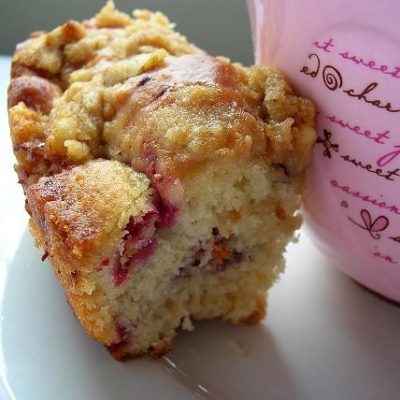
So with that I chose a very simple yet tasty coffee cake to celebrate my 2 year blog anniversary. A recipe courtesy of everybody’s beloved Dorie Greenspan. I made this to take to “coffee chat,” a monthly event they have for the seniors at my athletic club. Having been going to the arthritis classes I was allowed/encourage to come to the coffee chat. So naturally I went, I would hate to miss out on any of the current gossip. :P The recipe in the book calls for blueberries(which I am allergic to raw blueberries) but I went with raspberries. Any berries will work but not strawberries because of their high water content. It was moist and sweet but not dessert sweet, which is perfect for going with coffee and gossip.
Anyway, thanks to all of you who read my blog…long time readers and newbies a like. Here’s to another 2 years of butter and sugar ladened fat filled food 


Raspberry Crumb Cake

For the Crumbs:
 5 TBSP unsalted butter, at room temperature
¼ cup sugar
1/3 cup packed brown sugar
1/3 cup all purpose flour
¼ tsp salt
½ cup chopped walnuts

For the Cake:

2 cups raspberries, fresh
2 cups plus 2 tsp all-purpose flour
2 tsp baking powder
½ tsp baking soda
¼ tsp salt
¼ tsp ground cinnamon
1/8 tsp freshly grated nutmeg
2/3 cup sugar
grated zest of ½ lemon
¾ stick unsalted butter, at room temperature
2 eggs
1 tsp pure vanilla extract
½ cup buttermilk

Center a rack in the oven and preheat the oven to 350F. Butter an 8 inch square pan and put it on a baking sheet.
For the Crumb: Put all the ingredients except the nuts in a food processor and pulse just until the mixture forms clumps and curd and holds together when pressed. Scrape the topping into a bowl, stir r the nits and press a piece of plastic against the surface. Refrigerate until needed.

To make the cake: Using your fingertips, toss the raspberries and 2 tsp of flour together in a small bowl just to coat the berries; set aside. Whisk together the remaining 2 cups of flour, baking powder, baking soda, salt, cinnamon and nutmeg.
Working in the bowl of a stand mixer, rub together the sugar and zest together with your fingertips until the sugar is moist and aromatic. Add the butter and, with the paddle or whisk attachment, or with a hand mixer, beat the sugar with the butter at medium speed until light, about 3 minutes. Add th eggs one by one, beat for about 1 minutes after each addition, then beat in the vanilla extract. Don’t be concerned if the batter looks curdled-it will soon smooth out. Reduce the mixer speed to low and add the flour mixture and the buttermilk alternately, the flour in 3 parts and the buttermilk in 2(begin with the dry ingredients). You will have a thick, cream batter. With a rubber spatula, gently stir in the berries.
Scrape the batter into the buttered pan and smooth the top gently with the spatula. Pull the crumb mix from the refrigerator and, with your fingertips, break it into pieces. There’s no need to try to get even pieces-these are crumbs, they’re supposed to be lumpy and bumpy and every shape and size. Scatter the crumbs over the batter,. Pressing them down ever so slightly.
Bake for 55 to 65 minutes, or until the crumbs are golden and thin knife inserted into the center of the cake comes out clean. Transfer the cake to a rack and cool just until it is warm or until it reaches room temperature.

Adapted from Baking From My Home To Yours by Dorie Greenspan, Houghton Mifflin 2006

Next Page »